
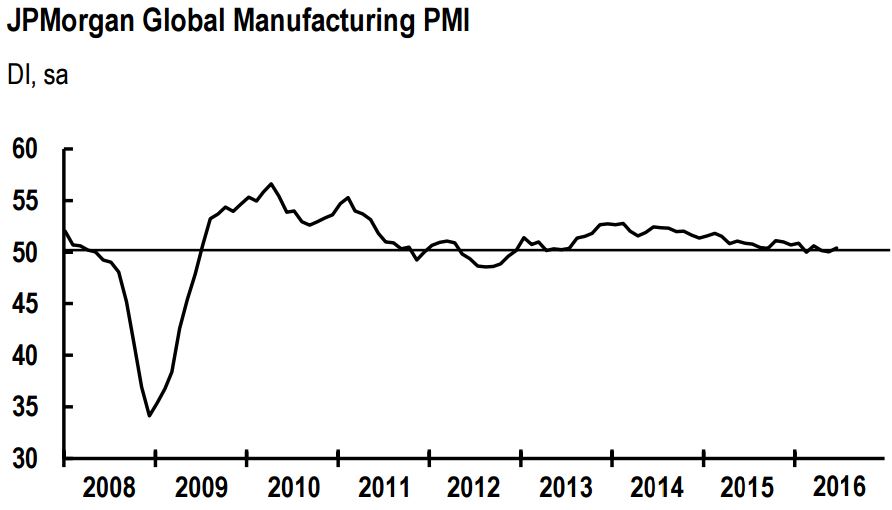
Behind all the wailing and gnashing of teeth over the BREXIT vote the entire hysteria (largely based upon the naive reading of events discussed HERE) may seem all rather childish as economic reality bites rather hard. To explain this there is one chart that should worry anyone with even a modicum of economic knowledge and that is the latest Global Manufacturing PMI chart below:
Source: Markit, JP Morgan Click/Tap to Enlarge
The PMI (Purchasing Managers Index) is widely accepted as on of the best leading indicators of economic activity both negative and positive, with the break-even line being 50, which is basically where it is now (50.4 to be accurate, 50 in May). Now the key thing to see here is how much it dipped below 50 in 2008, rebounding in 2009/10 before progressively losing momentum and volatility until is now hovering at a point of nil-expansion.
Now this is far, far, from the obvious disaster of 2008, however it is worth taking a brief reality check at this point as we are in a world of near universal ZIRP (Zero Interest Rate Policy) or even NIRP (Negative), a world still awash with funny money from QE off the charts in Europe and Japan and frankly epic stimulus in China the fact that manufacturing is slowly grinding down to a state that can only be described as moribund is more than a little alarming.
More to the point as momentum fades and there are no new channels of stimulus available* this chart shows a global economy at stall speed, with the inevitable breakout almost certainly to the downside which against a background of asset prices at absurdly high levels and markets that look alarmingly vulnerable (discussed recently HERE in the context of complacent pre-BREXIT commentary) the risk of a self-reinforcing economic failure gets ever higher.
(* Before Mario Draghi took the ECB into its QE madness last year he made it clear that monetary policy had limited efficacy at a speech at Jackson Hole in the summer of 2014, pointing out that Central Bank power is naturally limited and he was correct. The only Keynesian element of this monetary money printing stimulus is that it has allowed governments to maintain structural deficits, maintaining the dead-weight of the status quo rather than adding fresh demand and activity with the accompanying economic multiplier. As this inevitably fails through the weight of logic, and reality, we inevitably will see real Keynesian stimulus, which in the UK will almost certainly result in a generational infrastructure build out, one that is frankly very needed, with all the accompanying jobs, growth and the right sort of (!) inflation as part of the package)
As we have discussed many times before, this vast monetary experiment is failing as reality proves you can bring money to an economy but you can’t make it spend it. Indeed the latest pronouncements of Mark Carney in response to BREXIT talks about encouraging banks to lend begs the question to whom (other than over-excited property developers and the final blow-out house buyers)? Just as in Europe we see no reason why making tiny adjustments in how free, free money is is going to make any difference in a demand deficient, steadily deflating world.
After all let’s look at the impact of the latest heroic stimulus in China as it has built up its debt mountain even more rapidly to even less effect, as their latest PMI chart shows:

Source: Markit, Caxin Click/Tap to Enlarge
Indeed with China’s Services PMI (the one representing the booming consumer economy that’s taking over from manufacturing, mysteriously bypassing a 20 years of accelerated transition….you know, the narrative that’s fictional) coming in at just 50.3, so only very, very slightly positive, the idea the China is still churning out 6%-7% growth can only be accepted by the utterly credulous.
In fact such is the inefficiency of the Chinese debt machine some reckon that we are at the point where each new $1 of growth has been generated by $16 of fresh debt. This is beyond daft.
In the meantime capital flight is increasing almost everywhere, especially Japan, China and now post BREXIT vote UK, with vanishingly few safe havens other than German and Swiss debt (which is now producing a negative yield, so a guaranteed loss, even on bonds with 50 years to redemption). But what happens when even that loses its luster, as Japanese debt already has?
We simply don’t know, however there seems little doubt that the light at the end of the tunnel seems to be moving much, much faster towards us and we can be pretty damn sure it’s a big express train that has no interest in being our friend.
Frankly by comparison BREXIT seems nothing more worrying than the odd creaky sleeper.