
Sometimes profound points can be made simply by looking at something so wrong that it removes the need for much discussion. In the case of China it’s the use of concrete. Or more to the point the use of more concrete within three years than the US utilised throughout the ENTIRE 20th Century.
It is these major points in the narrative that are more important than the daily noise from stock markets, which in the short term are more emotional barometers, often only loosely linked to rationality, as we can see when after a bad day yesterday (following confirmation the Japanese economy was still struggling) the Nikkei market bounced by more than 7% overnight. All allegedly because the Chinese government talked of further aggressive stimulus to boost its flagging economy which, as we made clear yesterday, looks a little desperate.
China undoubtedly has achieved some pretty astonishing numbers over recent times, with (official) headline GDP growth slowly slipping from double figures to around 7% per annum, while the underlying economy has effectively more than trebled in dollar terms since 2007, which looks pretty miraculous. This in turn has justified the soaring prices of raw materials with the positive knock on impact for economies as diverse as Brazil, Russia, Australia and Venezuela, which have all reaped the benefits. This is clearly reflected in the breakdown of global trade we have examined before:
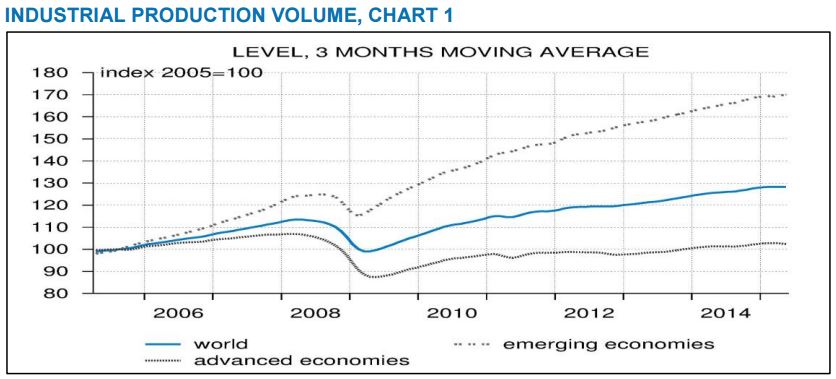
Source: CPB Click/Tap to enlarge
Looking back we can see how China benefited immensely from the years of debt fueled growth within Western economies prior to the GFC. It should be remembered that China had been welcomed into the World Trade Organisation (WTO) on very, very favourable terms in 2001 and soon became the natural go-to place for global manufacturing, with a hard working educated workforce, rapidly improving infrastructure and a willingness to invest and find solutions to almost every problem. By keeping costs low, by embracing improvements in efficiency and by recycling its growing reserves into helping the West finance its purchases China also helped disguise the excessive boom as cheap goods prevented headline inflation figures forcing up interest rates, while Western Central Bankers sat as oblivious and myopic about the asset bubbles they were blowing. Indeed China is a key reason why some politicians could deludedly believe they had banished “boom and bust”, as they surfed the headline numbers, never deigning to look below to see the economic equivalent of a Great White heading their way.
Once the GFC struck with numbing intensity China immediately witnessed trade volumes collapse as Western economies suddenly faced crashing growth combined with a combination of over-indebtedness, rising unemployment and a global trade system that suffered a heart attack as financing dried up for months. The response was immediate and China embarked on an unprecedented round of infrastructure building and development, while encouraging and stimulating as much internal demand as it could muster, desperate to maintain the momentum of pulling millions out of rural poverty. And, as far as the headlines were concerned this succeeded, with growth continuing apace and pulling neighbouring economies and commodity producers along in its wake.
However the excesses of the recent boom in China are of a scale that beggar’s belief with independent data pointing out that in the three years from the start of 2011 to the end of 2013 China used considerably more concrete than the US did in the entire twentieth century:
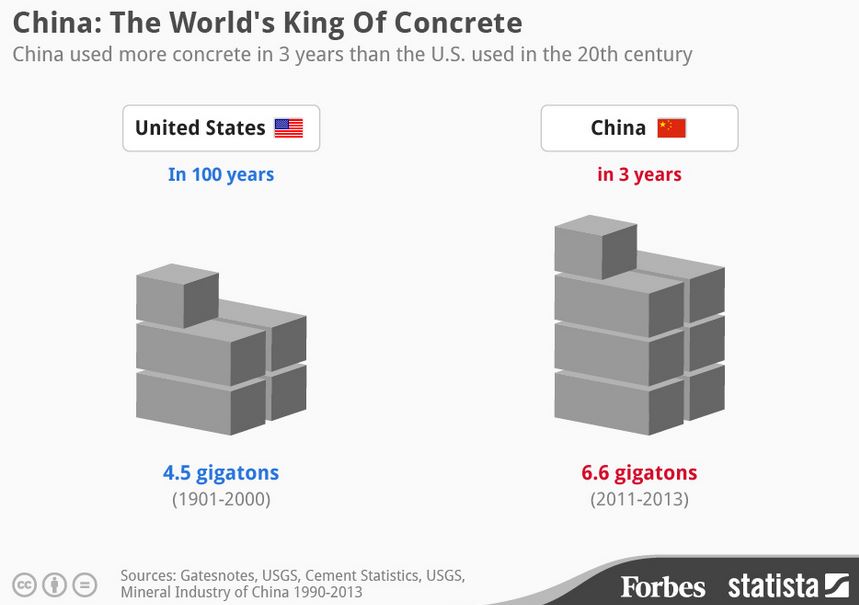
Source: Forbes Click/tap to enlarge
That is a thought that needs to be digested for a moment, or two, because over/malinvestment on that scale is likely to cause economic indigestion on a pretty epic scale. But with many of its export markets enjoying a stuttering recovery, at best, the question is asked how has this breakneck development been funded?
Simply by our old friend, and catalyst of the GFC, debt.
According to their regularly updated study “Debt and (not much) deleveraging” consultants McKinsey point out that total debt in the Chinese economy has risen from 158% of GDP in 2007 to 282% in 2014. Throw in the astonishing rate of underlying economic growth and that means debt has gone from $7.4tn (yes, trillion) to $28.2tn. Anyone not concerned about the viability of growth based upon these trends hasn’t really grasped the number involved.
However that is not to say growth is coming to an end, simply that there are very real reasons to be worried. It has been widely assumed that the Chinese government has had tight control on developments; that the invisible hand of the state was cleverly and knowingly orchestrating from on high and was ready to intervene and deploy its massive reserves when appropriate. However as events unfold there are a growing number of commentators who have been thinking that far from being brilliantly prescient the Chinese leadership has just followed the old tried and tested method of throwing money at a problem and hope it somehow sorts itself out.
This has been reflected clearly in domestic inflation which has been, by recent Western standards anyway, pretty epic with figures as high as 20% reported at times. That this has been a problem may have been evident early in the post, after all while Chinese growth rates have been impressively high it is hard to see how an economy can triple in around seven years when it takes over seven years for an economy to double at a 10% rate of growth. The difference is simple and it’s inflation. “Real GDP” is actually Nominal GDP (the total growth in the economy) less inflation (essentially non-productive price rises), so if you have 10% GDP Growth and 20% Inflation you actually have 30% nominal GDP growth. If we assume 10% inflation and 10% real GDP growth that still amounts 20% growth in a year in a rapidly evolving, growing and frankly rather disparate economy spread over a huge landmass you can see that some imbalances are likely to creep in, not least of which is the accuracy of the GDP figures.
A confluence of factors have enabled the Chinese to produce their stunning rates of growth for over a decade, however just as the West discovered a few years ago (before promptly forgetting) when you have to sustain progress by building debts ever higher to pay for it there will come a point when growth will slow dramatically and in a manner that is unlikely to be linear or gentle.
It is still unclear whether we have reached THE major inflexion point in the narrative flow of China’s recent evolution, however until we have greater clarity caution remains warranted as one of the greatest economic experiments inhuman history is starting to shows signs of tiring.