
We have been watching carefully for a large and unexpected shock that appears over the horizon too quickly for the financial commentariat to rationalise away. While the upcoming Catalan vote may generate ripples we see a potential real Black Swan may be closer to putting in an appearance than at anytime over recent years as the crashing commodity world cross fertilizes with increasing stress in the financial markets, making us ask seriously if something very prehistoric is on its way.
The news from the commodity complex has been unequivocally deteriorating over recent years, even as the fans of the commodity supercycle were still promoting the concept as the prices of most raw materials had been steadily falling since the sugar rush of QE2 began to fade in early 2011.
However there is a growing risk that things might be about to change rapidly for the worse in a rather alarming way as not only do the shares of miners and oil majors drag down stock markets but the realisation of systemic financial risk is suddenly thrown sharply into light by the plight of Glencore.
This commodity trading and mining giant floated, astutely, at the top of the commodity boom, having geared up to take advantage of the much heralded and very mistaken “commodity supercycle”. The company later geared up further to buy (less astutely) mining giant Xstrata even as the magic was vanishing and now finds itself facing questions over its future as its financial positions falters badly, despite a recent massive cash call. Should Glencore face further challenges and potentially fail it could represent a Lehman like Black Swan event, so heavily is it involved with the global derivative business and hence the banking system.
The key reason why the Lehman failure effectively toppled the banking system was the financial derivatives markets, which Warren Buffett described, correctly, in 2002 as “financial weapons of mass destruction”. Effectively Lehman Brothers was, amongst other things, a multi trillion dollar player in the OTC (Over The Counter – off exchange and usually unregulated) derivative markets, particularly in an esoteric financial insurance product, that had morphed into a speculators tool, called the CDS or Credit Default Swap. The finer details are unimportant here but suffice it to say when Lehman’s failed several trillion dollars of capital was frozen and chaos ensued.
Since then, thankfully, the CDS market has shrunk and increasingly migrated to regulated, collateralised exchanges, reducing their systemic risk massively.
Unfortunately this is not true for the rest of the OTC derivative market, which has grown enormously, with currency (or FX) derivatives, which are used for hedging trade (including commodities), taking a significant share of this growth. Hence should Glencore fail the knock on impact could be profound, with Deutsche Bank, considered one of the weakest global banks, in particular looking risky with a derivatives exposure reported last year to be worth around $70tn (yes trillion) or roughly equivalent to global GDP. Throw in the current problems of Volkswagen, if not the entire German car industry, with potential impact on further German trade and all of a sudden a very gloomy new narrative can be imagined.
The truth is that systemic risk within financial markets has grown over recent years, not diminished, while the opaque world of financial derivatives (which started life centuries ago as farmers and agricultural merchants originally hedged contracts for agricultural goods in the old Corn Exchanges) has now spread its tentacles into so many aspects of everyday life.
Regular readers may remember this chart from OPEC from the end of 2014, showing how Crude Oil supply and demand had been steadily diverging for sometime:
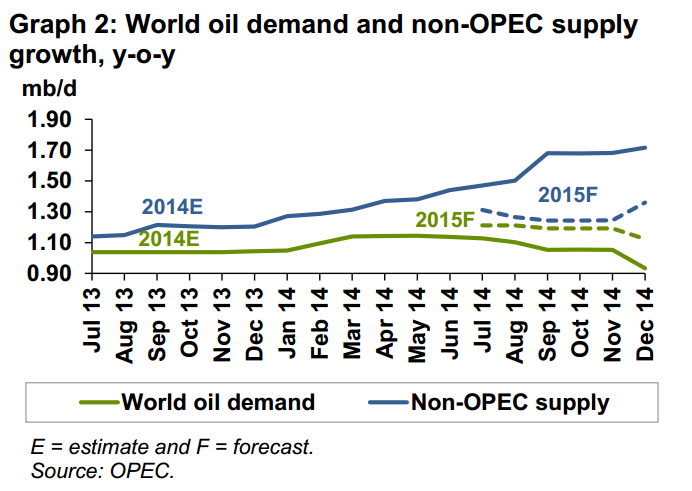
Source: OPEC CLick/Tap to enlarge
Yet oil prices had held up even as these supply and demand dynamics diverged, in large part due to the increased financialistation of commodity markets shown here:

Source: Commodity Futures Trading Commission Click/Tap to enlarge
Effectively you can see that as Nymex Oil futures activity dropped off (concurrently with the tapering of QE3 oddly enough) this steadily filtered through to the oil price itself, with the market suddenly paying attention to some fundamental issues that had been there for a while.
But this is not simply a story of commodities but of financial derivative markets that have become increasingly automated and ever more exotic in the aftermath of a global crash that they contributed so much to creating.
It is after all worth remembering that one of the key drivers of the October 1987 crash was early computer trading, while at the heart of the LTCM crisis in 1998, that turned a Russian default into a potentially bank breaking affair, were the clever algorithms of the eponymous hedge fund. Computerised automated trading can be inherently risky once the maths stops working, which inevitably it does under real world conditions.
Yet if we look back to 2003 US Options markets then provided a staggering fifty million price quotes a day. Now? That figure is eighteen billion quotes a day. Just as with the Chinese economy when numbers start getting too big for comprehension, and are moving at a rapid pace, it is foolish not to be a little cautious.
It is worth noting that recently market analysis firm, Nanex, which observes and reports on the esoteric world of high speed trading has observed that the underlying liquidity in the futures markets has diminished sharply relative to the size of the markets, even in the most heavily traded S&P futures. Utilising their historical records they have produced a very simple diagram to highlight just where they see liquidity in a historical context and it isn’t pretty.

Source: Nanex Click/Tap to enlarge
Remember the key elements in pricing any asset being bought or sold are supply and demand. If markets are illiquid it doesn’t take much to send them flying upwards as demand outstrips supply. This is great while it lasts if you are holding market assets. However if everyone looks to sell at the same time, producing lots of supply and there is no demand (and no longer anybody legally obliged to make a price like there used to be with NYSE Specialists or LSE Market Makers/Jobbers) the price can fall until someone steps into the breach, which may not be until the price is next to zero.
Anybody who isn’t worried by financial markets at the moment really shouldn’t be in them.