
With the US posting disappointing retail sales figures today, again, we are reminded that over the last few decades the US has evolved into an economy primarily driven by the consumer. Now this may appear to be so obvious to deserve a resounding “Well Duh!”from the reader, but bear with me because it appears to have been forgotten by the Fed, Wall Street and CNBC.
Last Friday the we had further strong Non-Farm Payroll figures from the US Bureau of Labor Statistics (BLS), showing that not only had 295,000 people gained employment in February, but that the unemployment rate had fallen to 5.5%. Bearing in mind that the US economy is largely driven by consumption a reduction in unemployment and more people earning money is surely good news, and to a degree it is….but the devil is in the detail…(and the detail is easy to find and easily represented in lots of easy to understand charts).
We have discussed before that the US BLS has this odd habit of kicking people off the unemployment register if they haven’t looked for work for as little time as four weeks. When this happens people fall off the labour participation rate, so don’t count as unemployed, even if they are.
Hmmmmm…..(with apologies to Grant Williams, of Things that make you go Hmmmm…fame)
As a result the participation rate has fallen dramatically since the crisis, although the bulls tell us this is OK as it represents older people retiring from the workforce. Hmmmm…..
Finally with unemployment falling wages should be rising strongly, hence necessitating a rise in interest rates in the near future. Hmmm….
Hokey dokey, let’s start with unemployment vs the labour participation rate:

Source: St Louis Fed Click/Tap to enlarge
Now the red line shows the headline unemployment rate, relative to the shaded bars of US recessions, over the last 55 years. While that rate has ebbed and flowed with the economic cycle the participation rate picked up inexorably before peaking around 2000, drifting gently down till the crisis at which point it plunges, pretty much in-line with the unemployment level.
However this is when the optimists tell us this is due to baby boomer retiring early out of the workforce, so what we will see is participation rates among 25 to 54 year old’s going up, while the participation rate of those over 55 will plummet.
So 25 to 54:
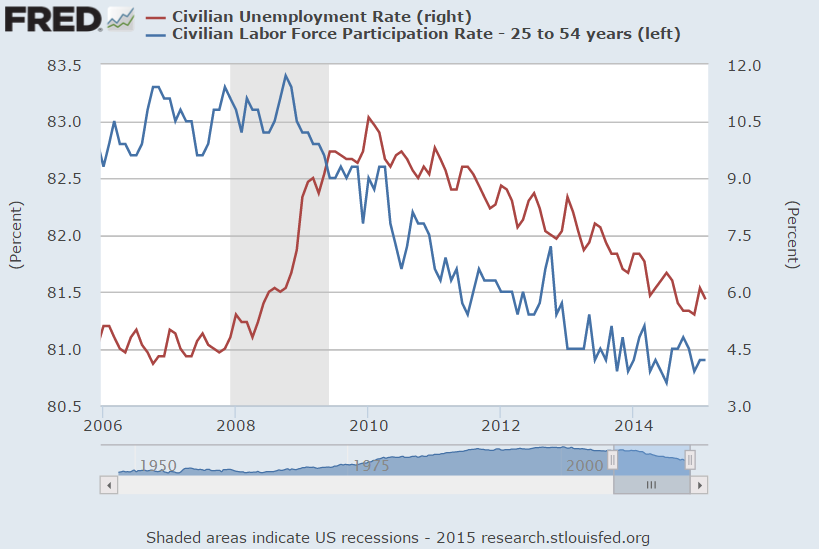
Oh!…..so as unemployment falls the number of participants in this age group falls…Hmmmm..
So the over 55s must plummet:

Oh!…so the over 55s aren’t leaving the labour force in droves…but the ones in their prime earning years are?…Hmmm
So how can that work, who is taking all the new jobs if the core workforce participation is falling. Well population growth probably has something to say about this:

Source St Louis Fed Click/Tap to enlarge
It looks like many of the jobs have been taken by new immigrants, which stacks up with analysis we have detailed in the past pointing out that well paying “breadwinner” jobs have been thin on the ground (and concentrated in the oil states, which is a trend that may be reversing sharply), while the majority of new jobs have been low paying, and are often part time jobs as these avoid the cost of Obamacare.
This is reflected in how wages for the average “Working Joe” in the US have been falling, while average wages have moved up only very slowly:
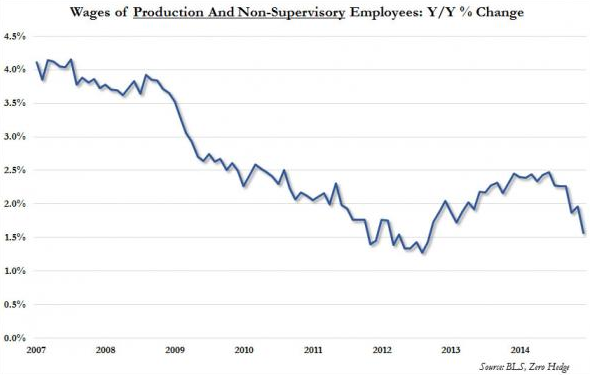
Source ZeroHedge Click/Tap to enlarge
Having covered this topic a number of times before and with the data readily available every time the BLS publishes, it remains astonishing to us how the granular facts are so widely ignored and mythic truths invented in their place. Bearing in mind how the Federal Reserves prognostications are still taken seriously, despite their own interest rate predictions being wrong (of their own rates for crying out loud) for year after year, we should perhaps stop being surprised.
But for now the simple truth is the US remains a consumer economy, which depends upon consumers having money to spend, ideally without adding to the debt pile. Without that it is hard to see growth accelerating anytime soon, with all the risks to the downside.
Indeed while we may see a single rate rise the most likely next step beyond that (if it truly occurs) could actually be QE4, rather than a new upward trend in rates. Won’t hear that on CNBC, which, to be honest, makes me feel reasonably confident.