
I had thought to title this post more along the lines that “There’s too much bearishness for me to feel really (short term) bearish myself”. With the markets wobbling, particularly in High Yield bonds and European Equity, and with the data coming in mixed (and sometimes puzzling) the worried commentary and bearish headlines are getting more noticeable. However as so many in The City and Wall Street are still doing nicely thanks and such has been the strength of Buy The Dip (BTD or for ZeroHedge and others: BTFD) as a guiding principle in some ways this feels a little bullish. Therefore is this just a slightly bigger BTD opportunity?
Maybe not because if you want to see how febrile markets really are you can simply look back at how negative the charts were for the US futures markets on Friday morning (8th Aug), as investors do seem to be paying attention to real world events, such as the re-involvement in Iraq of US forces, even if just from the air, for the moment. But then all of an instant the tone changed and we moved swiftly to the positive, and as I write the market is maintaining a slight improvement on the day. So what changed things, well looking at the timings it appears to be a couple of Tweets (yes, Tweets!) coming from the Russian side indicating a desire to de-escalate the Ukraine situation and encourage the Kiev government to talk to the separatists.
Now it is a stretch to take anything for granted coming out of an ex-KGB man’s government (and to all those US bloggers who hate Obama so much they tend to side with Putin….really? I know events like NSA snooping and IRS laptops being mysteriously destroyed are a damning indictment of poor government behaviour in the US but dig into a little recent Russian history…please, Putin IS WORSE than Obama…see Chris Patten’s recollections of the man in a recent Project Syndicate article, well worth a read) but to have a relief rally on the back of such comments appears to be ludicrous. Indeed the Tweets could easily be re-interpreted as “we will be making Kiev and the separatists talk after our peacekeepers are in control of the country”, which would not be a reason to celebrate.
To be fair I am increasingly of the view that the narrative of “markets have rallied because…” are getting weaker as SHORT TERM explanations because sometimes the market is just following it’s own internal narrative and external events are, in effect, an excuse.
Nonetheless it is impossible to deny the impact of the current problems in the Ukraine on the economic outlook, particularly after we witnessed the shocking sight of Italy falling back into recession for the third time since the Global Financial Crisis began. And bear in mind this is BEFORE the tit-for-tat sanctions have an impact and, heaven forbid, any possible reduction in Gas supplies. Worse is not only how the economy has not got anywhere near its pre-crisis high but that on a a per-capita basis the GDP is back below 1999 (pre-Euro) levels:

Click/Tap to enlarge
Now as a true lover of that marvelous, beautiful country I know Italy needs to make significant economic reforms to release the potential of its populace. However it is stuck within the straight jacket of the Euro, with Debt to GDP growing, even after it has been successfully running a primary budget surplus (the government spending less than it receives, ex interest payments) making it virtually impossible for it to enable the necessary changes, all of which would introduce some degree of upheaval into an already fragile environment.
Returning to the point however there is no doubt the real world isn’t looking too hot, which frankly shouldn’t be a surprise to anyone following the underlying narrative of ACTUAL EVENTS rather than media led hopium.
As a result we find ourselves sitting in a kind of limbo, awaiting events and hoping that Vlad isn’t an invader, because if he is the fragile illusion that all is well in financial markets will be well and truly shattered.
After the weekend I will be providing a more detail about some of the unfolding worries within the dynamics of financial markets themselves, which I believe inform us that perhaps we really should be getting worried about a serious change in direction, but I will leave you with a couple of thoughts. The first is from Market Watch commentator Brett Arends who points out that if you take the US stock market and look at Medain, as opposed to Mean valuations the US markets look heroically overvalued, worse still than 2000:
Median Earnings (PE) are 20 today, compared to 16 in 2000. The median stock trades at 2.5 times its book value, against 2.2 14 years ago, while now the median stock trades on 1.8 times its revenue (remember top-line revenue tells you more about sales growth) against 1.4 in 2000. Now those wizened enough to remember the tech boom may scoff but remember back then the dispersion of valuations was at record highs, with real (traditional money making businesses) world stocks often trading on single digit PE ratios. Now we see US utility stocks making all time highs whenever tech comes off and vice versa. It doesn’t mean a crash is imminent just that stocks are very expensive across the US market.
Finally let’s have quick look at government bonds, the market that really thinks about the big picture. Over the last few weeks, US Treasury yields have steadily fallen for longer maturities, indicating growing caution. In Germany yields have fallen so low, some are effectively negative as investors seek security in the safest of European debt (and BTW take a currency hedge on a Dmark/Northern Euro likelihood). With German GDP figures out next week speculation is growing they will be negative and during a conversation with the Head of Fixed Interest at a successful, and skeptical, City firm this week we discussed that the German government bond charts are looking worryingly Japanese as yields slump ever lower. Like me he believed Germany continues to learn the wrong lessons from history, specifically that it was deflation that did for Germany in the 1930s, not the inflation of the 1920s.
So to Gilts, where below is a price chart of the 4.25% 2036 Treasury stock, a useful proxy for long dated gilts generally, showing how it rallied following the mini-crash of 2011, providing investors with a significant capital gain and a locked in income yield. It then traded in a range until mid 2013, before slowly easing off as equity markets gained in confidence. Yet over the last few weeks it has crept up again, alongside other long dated gilts, with barely a murmur from the mainstream commentariat. Who knows, the Gilt market may be wrong and the clever money may be putting short positions on long dated Gilts as I write, but I’m not so sure.
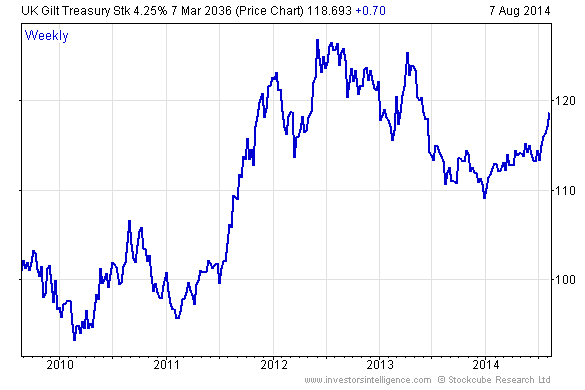
Click/Tap to enlarge
Next week we look at some real fixed interest fragility undermining markets (assuming Vlad hasn’t invaded over the weekend) but in the meantime let’s hope for a peaceful Saturday and Sunday.