
Despite further intervention by the Chinese government (including the establishment of a whistle blowing website for “malicious selling”…………..which is a bit of a credibility killer!) the Shanghai market remains weak, while more and more of the commentariat are looking at commodity prices and beginning to wonder if there is a problem out there (spoiler alert..there is). Alongside developed stock markets that remain well off their recent highs there is a rational sense of anxiety out there. Good to know then that at least the UK economy had the decency to turn out healthy numbers, more-or-less in line with market expectations.
The headline figures are 2.6% annual growth with 0.7% in the last quarter alone, and although historically these look pretty average, in the post GFC world they are actually rather healthy and finally take our GDP per capita back to pre-crisis levels.
Particularly encouraging is the that there is some strength in production, which has been lagging the rest of the economy through the recovery, although the largest growth within this sector was in quarrying and mining, so may be linked to construction, which itself was flat in the quarter:

Click/Tap to enlarge
As you can see however services continues to be the most robust part of the economy.
Looking internationally the UK economy also looks moderately good compared to some of our natural peers, as the following chart highlights:
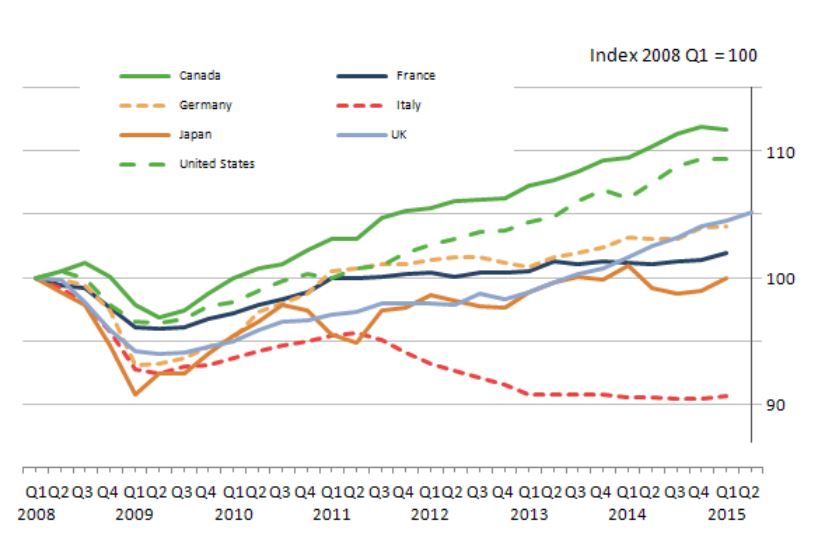
Source: ONS & OECD Click/Tap to enlarge
Indeed the UK appears to be maintaining a steady momentum, which the US and Canada appear to have lost (US GDP on Thursday could be very interesting), while the “powerhouse” of Europe, Germany, seems to be running out of steam (one reason why it can’t afford to bailout all of Southern Europe, although ironically if it weren’t so obsessed by its balanced budget policy it might be growing somewhat more robustly). Meanwhile Italy is busy proving what a successful policy full austerity (rather than pretend austerity, or austerity-very lite that the UK has had) isn’t at encouraging growth.
However hidden behind these charts it is worth noting that while our rate of growth is faster than austere Germany we continue to run both a budget (government spending) deficit and a very significant trade deficit. While I remain a little suspicious that the latter is as bad as reported, biased I suspect by some of the capital flows in our income from foreign investments, it still remains far from optimal, and while the government deficit may be falling – slowly- it is still a deficit and we are not making inroads into our national debt, which remains worryingly large.
Does this means we should go all austere and balanced budget like Germany, far from it…for the moment. I have argued repeatedly that serious economic reform, which we still need, in a time of recession or depression (which is what Germany wants Southern Europe to continue with) is almost mathematically impossible, particularly in economies heavily reliant upon consumers. After all it is consumers who find themselves turfed out of work, on lower wages, or worried about being turfed out of work by the reform process. This reduces consumption and oddly enough (I mean totally predictably) increases government costs via social security, while reducing income through reduced tax revenues. Then we have the second line impact of these falling incomes on other industries both home and abroad and so on, making it very difficult to invest in reform to compete with the robust, well funded, ultra competitive industries of the country that, interestingly, is telling you to embark on obviously counter-productive austerity and reform concurrently. Indeed what you need in those circumstances is for countries doing well to stand up and spend and import more from you….Germany, Germany, anyone seen Germany?……. Beuller, Beuller?
No full blown austerity won’t work until the global economy is on a more robust footing (which will probably be following the next global crisis when real inflationary Keynesian stimulus is likely to be applied hard rather than the bizarre trickle down monetarism of QE we have at the moment) and the government is hence treading (imperfectly) a fine line, which at the moment appears to be succeeding. However we cannot disguise that despite these encouraging figures we remain worried the UK economy remains too reliant on debt, consumption and property and is hence vulnerable to the financial shocks we anticipate.
However we remain optimistic that corporate Britain, or UK PLC, remains in pretty robust health, particularly those companies not forced into short term financial engineering by the market*.
We know many companies are hoarding cash and good staff, rebuilding balance sheets and generally have a more conservative and even pessimistic view of the future than either the City or Wall Street.
Hence as we face an inevitable slowdown in the not too distant future it is best not to be too bearish about good companies, just remember though that share prices of even the best of them can go down (a lot) if they are overvalued in the short term, or simply because of market panic, because, as we all well know markets aren’t always rational.
*(It is worth mentioning we have discovered that many large companies are currently finding it very difficult to adopt policies of increasing real growth via investment and capex even if they want to. THey find themselves forced by their largest shareholders, increasingly passive funds, to focus US style on short term EPS growth and total shareholder returns rather than good business practice…a fact they don’t/can’t advertise widely…more on this in another post)