
Regardless of what the real world throws at markets (and there is, on balance, more to worry about than not) one story continues to dominate almost all discussions about financial assets, and that is what happens when the US Federal Reserve finally begins to raise interest rates, something it has been telegraphing for some time. We feel this is a little odd, when it is real growth and real earnings that should be driving asset prices, but such is the nature of today’s markets.
In fact this event has become the latest obsessive totem for an industry that seems currently locked in a myopic avoidance of critically analysing ANYTHING that might upset it. After all if rates rise to 0.5%, from 0.25%, how much real impact will this have on most individuals and businesses? In short not much. Let’s face it, starting at a base of just about nothing to a bit less of nothing won’t be a problem for anyone who shouldn’t already be in talks with bankruptcy lawyers, so it looks like the worry is more of a psychological issue. Perhaps the market really believes the Fed is prescient (despite all the evidence to the contrary) and if it’s going to raise rates things must be getting better. Hmmmm…
While it is certain that one day interest rates will rise it is worth remembering that in reality the Fed has been anticipating raising its own rates for, well, quite a while, as this chart showing previous guidance (originally highlighted last year) demonstrates (Note: Each line starts when the Fed made a set of interest rate predictions and follows those predictions through the following quarters):

Source: ZH Click/Tap to enlarge
Let’s be honest here; when an organisation is this catastrophically bad at predicting the outcome of its key function in life we should probably stop taking it seriously (indeed I stopped taking the Fed seriously well over a decade ago as it makes Tea Leaves look usefully predictive…although it turns out it is a wonderful subject for a book) so it remains puzzling why everyone is so certain US rates are going up soon. After all it was supposed to be happening in June, then the betting moved to September, but after the Doveish Fed statement last night it is perhaps now December, or perhaps early 2016…….but soon(ish)…..really. I’m not sure why it is always the last month of each quarter that pundits chose for a rate rise, so in the unlikely event rates go up this year I’m going to say November…just to be different.
Still we did get some guidance from the Fed yesterday evening, which can perhaps be best described as ambivalent, observing the job market looks to have improved slightly with “solid” job gains, but also pointing out the outlook is balanced and they are watching inflation and related wage settlements closely, while some business data is soft. This was taken to mean a September rate rise is less likely so risk assets responded well.
The real tester however is going to be the release of the US second quarter (Q2) GDP numbers later today. So far the leading economic indicators make us believe the headline figure will likely be lower than the estimated 2.6% (annualised) unless the rather troubling inventory build up continues to flatter output. However if inventories have begun to be drawn down to supply consumption, with production stalling (which some local Federal Reserve figures indicate as a possibility ) then the actual outcome could seriously disappoint.
Such a possibility should be considered because the economic picture from the world at large is looking ever more uncertain, particularly when you ignore the official Chinese GDP numbers which remain a happy fairy tail compared to the real narrative which is beginning to look a little bit more Brother Grimm. The latest thought provoking data is that covering global trade, with the latest figures from the Global Trade Monitor showing that not only is trade slowing down, but it may have stalled, with a fall of 1.2% in May and an increase of just 1.5% over the previous twelve months. Graphically this looks troubling in a world where the world’s largest economy is supposed to be about to raise rates:

Source: CPB Netherlands Bureau for Economic Policy Analysis Click/Tap to enlarge
This trend ties in with the weak commodity complex and falling shipping rates we have discussed in previous posts…it does not tie in with ever optimistic discussions of a building cyclical recovery.
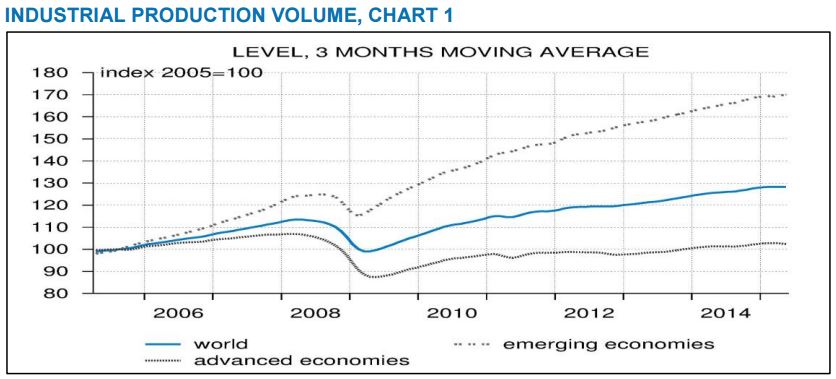
Perhaps more troubling is to see just how dependent the last few years of global trade has become on Emerging Markets, compared to Developed Markets, which are still below their 2008 peak:
Source: CPB Click/Tap to enlarge
If we are correct in believing that the Emerging Market slowdown is worse than most believe, which our own analysis indicates, as does that of a number of EM specialists we talk to, then we could be witnessing a turning point in the global economy. Indeed this morning we witnessed the release of German engineering output, which surprised with a fall driven largely by a drop in orders from the emerging markets.
If this is heralding a larger global problem then with Zero Interest Rate Policy (ZIRP) already a near universal reality there really isn’t that much ammunition left in the tank to fight a fresh slowdown.
Ironically of course it is this conundrum that we believe is the main driver for the Fed and the BoE to talk about raising rates, as the leading indicators and inflation trends really don’t justify it. It is the need to create wriggle room for future policy action that we believe is driving the quest for higher interest rates, not real inflationary pressures. However central banks may already be running out of time to prepare their armoury, unless that is they want to precipitate the very crisis they so fear with their own action.
Perhaps we will have a better idea this afternoon.