
Finding yourself on BBC radio, trying to reduce detailed analysis into a few easily digestible minutes is hard enough; however when your mind is busy trying to cope with the statements from the other interviewee that sounded like Orwell’s Thought Police (from 1984) had got to him it can put you off your stride. The interview was for Adrian Chiles lunchtime show as the markets were busy falling over a couple of weeks ago and we were there to provide the view of the (mildly…ahem….. Bearish) professional investor as a counterpoint to the views of a British Professor tenured at a Beijing University, who happily informed us not to worry about China because ” They set ambitious growth targets and the keep hitting them”……….The phrase “Ignorance is Strength” came to mind .
Unfortunately you cannot shout out on national radio: “Of course they hit their own targets you blithering idiot……They’re all made up”. It’s just not done; even if obviously true.
Now anybody who receives investment industry marketing, watches CNBC or Bloomberg, or reads the FT, is largely bombarded by positive news, with so little potentially Bearish opinion it’s not surprising, on one level, to see almost every stock and bond market reach levels that, based upon fundamentals, are simply daft.…It’s the zeitgeist…The popular narrative (or at least it is in the City and the canyons of Wall Street, if less so in the real world)….The world’s recovering, momentum picking up, sunny uplands here we come……Indeed even with growing uncertainty, that markets are finally reflecting, the lack of comprehension on show is still surprising; particularly about China.
To be fair it is easy to be overwhelmed by Chinese growth, which has brought more people out of absolute poverty, more rapidly, than any other event in history and although it has been far from a pleasant process for many there have been none of the mega-deaths which have tragically accompanied other periods of rapid change in China. However the two dimensional analysis (or more specifically the lack of detailed thought, let alone analysis) is mystifying, other than it slips easily (lazily) into the myopic world view of those doing well out of the recent years of financial incontinence (so the City and Wall Street in particular)
Yet the issue is writ large if we look at the most basic data reporting, with China now (in)famous for producing GDP figures that are not only the first to be produced by any major economy but, more importantly, are ALWAYS within fractions of a percent of their anticipated targets. Hence if they target 10% growth it will be between 9.9% and 10.2%, depending on how they want to spin the growth rate. As headwinds have built over recent years that target has fallen and the latest target was 7%, but with signs of a slowdown growing, with poor leading indicators coming from China and her near neighbours (discussed HERE and HERE), it was expected to miss that figure: but didn’t. This lead to wonderful headlines like this in The Guardian (which should know better) “China surprises economists with GDP rise of 7%” followed by “China has confounded expectations……with Gross Domestic Product rising by 7%…..Analysts had widely predicted that economic growth would dip from 7% in the first quarter to around 6.8% in the second.”
Or more accurately: Any analyst with an ounce of common sense thought they’d report a fictional 6.8% rate, slightly lower than the fictional previous 7% rate to try and convince the world that; yes things are slowing but its all under control…..even though they clearly aren’t.
Actually reporting 7% indicates a need for ridiculous bravado that should probably cause a bit of panic.
But no that isn’t what is reported and I still talk to lots of people in the investment industry who will blithely quote this utter nonesense, not only with a straight face, but with a shattering degree of credulity.
But don’t just listen to Prometheus. Listen to current Chinese Premier Li Keqiang, who in 2007 (when he wasn’t yet Premier) told the then US Ambassador to China, Clark Randt, that he should look at three variables as the best guide, electricity output, rail cargo and bank lending. According to Randt: “By looking at these three figures, Li said he can measure with relative accuracy the speed of economic growth. All other figures, especially GDP statistics, are for “reference only” he said smiling.”
Now this is hearsay, from official US documents revealed by Wikileaks, but most serious China watches DON’T take the official figures seriously and do watch the other data, although with the above having come to light a few years ago it is generally thought those snippets of data are now also heavily gamed by the government.
Nonetheless this got me thinking as in a recent post (HERE) commenting on the unsustainable and debt ridden nature of Chinese growth, highlighted by the ridiculous over consumption of concrete in a chart so wonderfully simply I just have to republish:
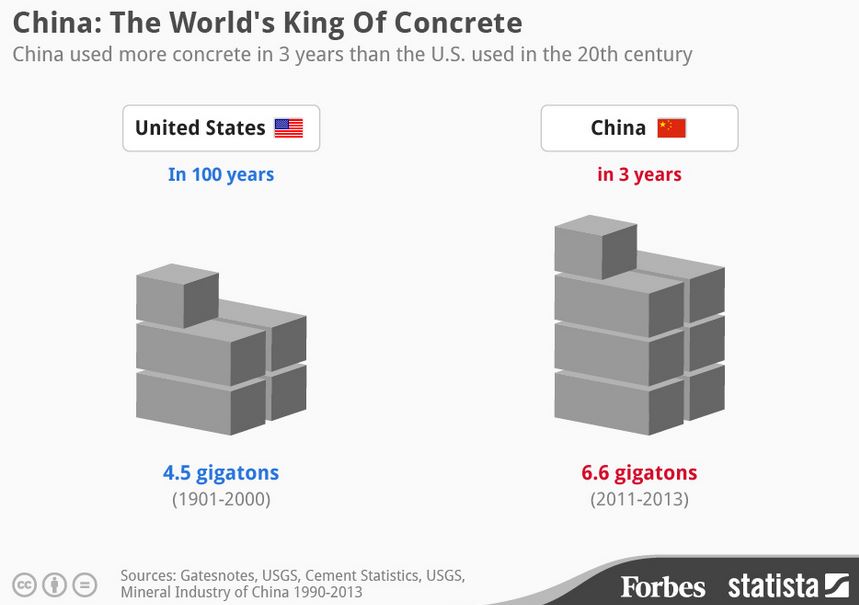
Source: Forbes Click/Tap to enlarge
In that post I discussed how inflation had been so high that it totally distorted the growth of real GDP, even if you took the official figures at face value, which for this exercise I will (if you don’t the following looks even worse).
Now we know that Chinese debt has blown out dramatically in funding the last few years of breakneck pace and that the percentage growth of debt is pretty terrifying against an underlying GDP that has more than tripled since 2007 (Graph from the excellent Mckinsey report: Debt and (not much) deleveraging, available HERE).
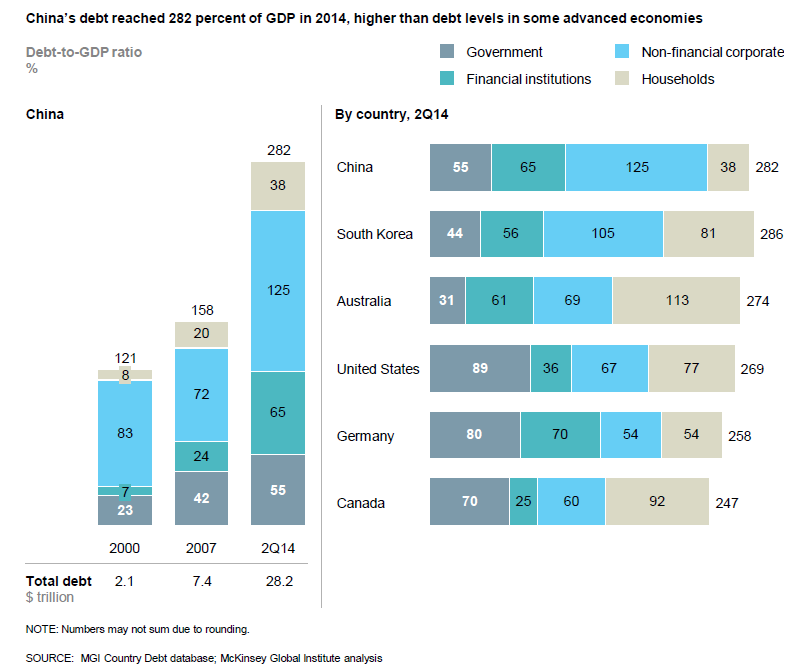
Source: Mckinsey Click/Tap to enlarge
Now I think it can be unfair to compare an annual snapshot GDP figure against total debt if you want to measure the efficacy of that debt in providing growth. The debt builds up over time, while the GDP figure is for just one year. On that basis if you add up all the additional GDP generated, over and above the 2007 baseline and compare it to all the debt added in that time you find that ever 1 dollar of GDP above the 2007 figure was bought with 65 cents of debt. That is incredibly, horribly, Soviet Union style, inefficient as you can get…but wait it gets worse.
On of the most important things to appreciate about real growth is that it is measured as nominal (total) growth, less inflation. Hence 10% nominal growth, with 5% inflation is 5% real growth. Now if we take the official Chinese figures and compound the rate of real, non-inflationary growth since 2007 we see the debt/GDP figure reverse and actually it’s taken a full dollar of debt to generate 65 cents of growth. This is heroically bad. Let’s face it if you borrow £1 and immediately spend it in a shop you have generated £1 GDP for £1 of debt. Borrowing £1 and generating only 65p of GDP is less than optimum.
Now I can see how this metric could this understate the level of growth unfairly on one side, while the counter is that the official inflation levels are absurdly lower than the reality experienced on the ground (which would also indicate real GDP levels that are also too high) and observed by businesses operating in China. Arguments can in fact swing one way then the other but the one fact you can’t ignore however this does not represent a growth “miracle”, more another example of throwing shed loads of cash at a lot of opportunities and hoping for the best. The history of such rapid balance sheet expansion, of gearing up regardless, is replete with examples of this not ending well, and in some cases leading to crash or even catastrophe and unfortunately we can’t say if there are examples of this behaviour ending happily, with smooth transition and imbalances correcting without a glitch because we can’t find them. If there any, are can somebody let us know?
How this will develop is literally anyone’s guess and until now I have reserved judgement as China is nothing if not unknowable in its entirety and I have given the benefit of the doubt to the fact the leadership knows roughly what its doing.
However it was the BBC interview which highlighted so sharply the certitude of the mainstream view, the lack of intellectual rigour in analysis and the complacency in the face of disturbing contradictions within the data. Bearing in mind the mainstream has predicted few, if any, of the major events over the last two decades of the debt debacle (until after the fact of course) this makes it hard not to conclude that the inevitable evolution in China’s development has the potential to get rather messy rather quickly, with unexpected consequences. As ever the timing is uncertain but just as China has been a major part of the rapidly dissolving Corrosive Equilibrium, so we might soon find out just how corrosive it’s own internal balancing act has become.