
2018 was tabled as the year that Central Banks began to unwind their big QE experiment as they anticipated normalised growth, interest rates and a final “recovery” to normal conditions from the post-GFC “lost decade”. Expectations were well represented in the following Citi chart produced just a couple of months ago before markets began getting ever so slightly fragile:

Source: Citi Research Click/Tap to Enlarge
However as markets decided applying some sort of rational valuation metric might be, well, rational (so a lot lower) it appears that some Central Banks became rather Augustinian (“Lord let me be pure – Just not yet”) in their outlook as we can see beginning with Mario Draghi’s ECB, which to be fair is worried about a lot more than just equity markets, more Italian politics and banking:

Source: ZH, Goldman Sachs Click/Tap to Enlarge
Not a huge pick up in QE, but significant nonetheless.
Looking East the Bank of Japan also decided it had to pile on the moral hazard (remember when people were really worried by this concept, concerned it could lead to reckless behaviour, misallocation of capital and fresh bubbles……like what’s actually happened? Amusingly those fears were one of the few occasions mainstream thought got it right, before promptly forgetting it in the rush of “I’m alright Jack” markets):

Source: Bloomberg Click/Tap to Enlarge
This has led to the frankly absurd situation that the BoJ now holds around three quarters of all the outstanding Japanese equity market Exchange Traded Funds (ETFs) as the ZeroHedge chart below shows, highlighting how the BoJ purchase have shadowed (driven?) the ETF market through time, with the total percentage holding displayed on the bottom line:

Source: ZeroHedge Click/Tap to Enlarge
As a result the astonishing charts on Central Bank Intervention Balance Sheets don’t get any less extreme as the following 720 Global chart shows, which although describing “Global QE” includes other measures such as ECB LTRO operations in the early post crisis days as well as China’s PBOC hosing up anything dodgy that moves:
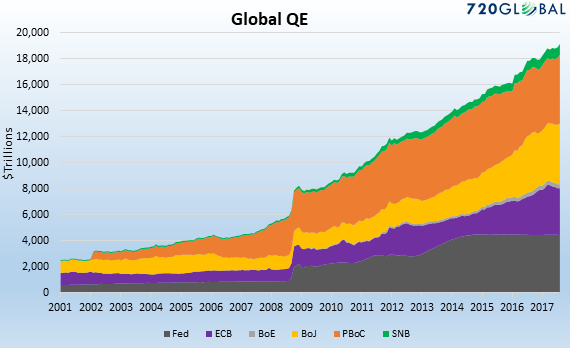
Source: 720 Global Click/Tap to Enlarge
Interestingly this chart shows the one Central Bank that hasn’t been increasing it’s balance sheet in recent years, specifically the US Fed at the bottom of the chart. As the first chart at the top of the post demonstrated the Fed is not only the first CB to begin raising rates but is also the first to begin reversing QE, embarking on what has become known as Quantitative Tightening (QT), with unknowable consequences both for the US economy and global markets, although the risks are significant enough to fill two separate coming posts.
Whether these growing risks will make the Fed change course is open to question however, because the new Fed Chair’, Jerome “Jay” Powell well knows that QE has caused massive distortions and excessive risk taking and losses are inevitable when the Fed does raise rates (as we showed from Fed minutes from 2012 HERE) so why worry when what he predicted comes to pass?
More pointedly for other markets however is that there are signs that the “synchronised global recovery” so beloved of the markets and press may be proving to be the “synchronised short-term global up-turn” the OECD actually predicted (which in turn spawned the “synchronised global” meme that rapidly became so distorted to the positive) last year and which we have discussed previously (HERE), perhaps reflected as economic surprise index measurements have turned down of late:

Source: ZeroHedge Click/Tap to Enlarge
How this pans out is unknown at the moment, but market valuations remain highly elevated, leverage of all sorts is higher than in 2007/08 and even the now weakening growth appears to remain disturbingly debt/special measures dependent.
So far only the stock markets are really showing signs of stress but if this begins to spread to other markets the risk off environment could accelerate rapidly and unpredictably. Although not an immediate base case it seems more probable than at any moment since the unofficial Shanghai Accord rescued markets in early 2016, which it should be remembered was at a time of pre-Trumpian global co-operation.
This time could be rather different.