
There are two explanations for the current rout in banking shares, one is relatively benign (if not supportive of a future rapid rebound) as it means the obvious has suddenly become visible to the myopic and is causing them to panic. The other possibility is much more worrying as it could mean we are on the cusp of a genuine disaster. You see back in 2008 the world was clearly in a funk, Northern Rock had gone bust in the UK in 2007, other small banks were struggling, while Bear Stearns had popped in March 08, so financials were already an unhappy place. However as we moved into September, behind relatively stable equity and bond markets one unregulated market was moving quickly. That market was the Over The Counter (OTC) Credit Default Swap (CDS) market, which blew out in value indicating the banking system, and very specifically Lehman Brother, was in deep, deep trouble.
That same market is now telling us that German behemoth Deutsche Bank (DB) may be going the same way and if this is correct we are in a lot of trouble.
Now we have covered the travails of DB and the OTC markets a number of times (for instance during discussion on the ECB’s pre-QE ABS scheme in 2014 and the unregulated OTC derivatives market HERE and HERE with our worries about Glencore and the….errr….unregulated OTC derivative markets) but it is worth remembering that DB’s exposure to the unregulated derivatives market was in the order of $70 trillion (yes trillion) back in 2014, or the equivalent of global GDP.
At the time it was pointed out that this number was the Gross exposure of their positions, while netted off (with long positions on specific assets/currencies/interest rates offset by short positions on the same assets) was merely in the $30bn region. However this position is naive as it ignores the lessons that became clear after Lehman’s failed (which Prometheus in his old home had warned about very specifically) and the unregulated markets seized up, freezing Trillions of dollars in capital, instantly bringing down AIG, with the rest of the global banking system only saved by massive government intervention.
You see when a single counter-party (trading partner) fails in these unregulated markets effectively all the capital of all the banks in the markets is frozen and, all of an instant, the banking system stops working. It happened then and could easily happen again as very little appears to have been learned since 2008, or what was has been learnt has also been rapidly forgotten….unless the smart players who realised Lehman’s was on the way out now feel the same way about DB as Lehman’s as their CDS blows out in a way that has been described as a “Viagra” (straight up) breakout pattern on the chart:

Source: Zerohedge Click/Tap to enlarge
You see effectively the CDS is an insurance policy on a company bond…..hence the Credit (the debt or Bond) Default (it fails) Swap (a financial risk instrument where one party effectively pays a premium to shift a risk). This sharp move puts them on a level not seen since the Eurozone crisis in 2011, although they still have a way to go to 2008/9 levels.
The thing is that DB’s problems are more than just the opaque OTC exposure but also relates to the fact that DB reported a whopping loss of €6.8bn for 2015 and felt the need to confirm last night that it could cover the interest on its lowest tier debts…..in itself seen as a sign of real boardroom fear.
Put that against the unknown (but clearly significant) bad debts held by the US banking system against the oil patch and the fact that Italy would like to create a Bad Bank (to take on board the dodgy debt from three struggling banks), but can’t, and the systemic fragility is writ large.
Hence the fear that the market is so febrile because some well informed sources are 90%-100% that a big failure, very possibly DB, is almost inevitable. If that happens can governments react fast enough? And, more to the point, what will Central Bankers do now they are all stuck at the Zero Bound, or even in Negative Interest Rate Policy (NIRP) territory? There is no dry powder left.
It needn’t be this bad!
At the start of this post we pointed out that the current adverse price action among banks could be one of two things, either the fear/knowledge of an imminent major failure, or simply the fact that better analysis is being done of the current condition of the banking sector.
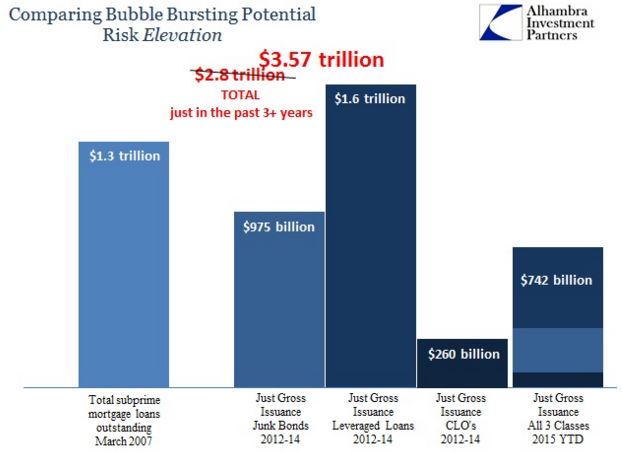
As mentioned above, although US Banks have probably been the most assiduous in strengthening their balance sheets since the GFC it is increasingly clear that there are growing bad debts within the oil space. More to the point despite the headlines balance sheets looking better the cross connections within the asset management market and the continuing Shadow Banking system, opaque as they are, need watching as the US has been a debt binge unparalleled in history, even by early noughties standards. For a simple graphical explanation the chart below from the excellent Alhambra Investment Partners (full post HERE) demonstrates how much low grade debt has been issued between 2012 and 2015 and compares it to the outstanding mortgage related debt that precipitated the GFC back in 2007:
Source: Alhambra Click/Tap to enlarge
This should cause markets to worry and should shake some complacency out of investors, but there’s more.
Moving to Europe we mentioned above the Italian banking situation which has blown up over recent weeks, although few outside of markets understand how worried many are becoming, however this seems nothing next to the 20% fall yesterday in Greek banks as investors again look at the essentially bankrupt state and wonder what happens next. Furthermore as we have discussed before the new bank “bail-in” rules, trialed in Cyprus a couple of years ago, which came into force this year convert any larger depositor into the equivalent of a bond investors as deposits over €100,000 become liable to be used to re-capitalise any failed bank….essentially changing the nature of money/savings.
Additionally of course is the problem of China, where most of the massive blow out in debt creation has been focused via the banking system, which is now struggling to survive. Now the Bulls will argue that we shouldn’t worry, that in a command economy the banks can simply be re-capitalised, debts written off and business carries on as normal, however not so fast. The Chinese banking system is increasingly globally interconnected now and plenty of overseas banks have exposure, particularly larger European Banks. Now if there is a systemic banking collapse in China that requires state intervention do you think China will give too hoots about making Western Banks good, even if it is in their long term interest?
The answer from the way they treat other Western industries would point to a resounding NO!
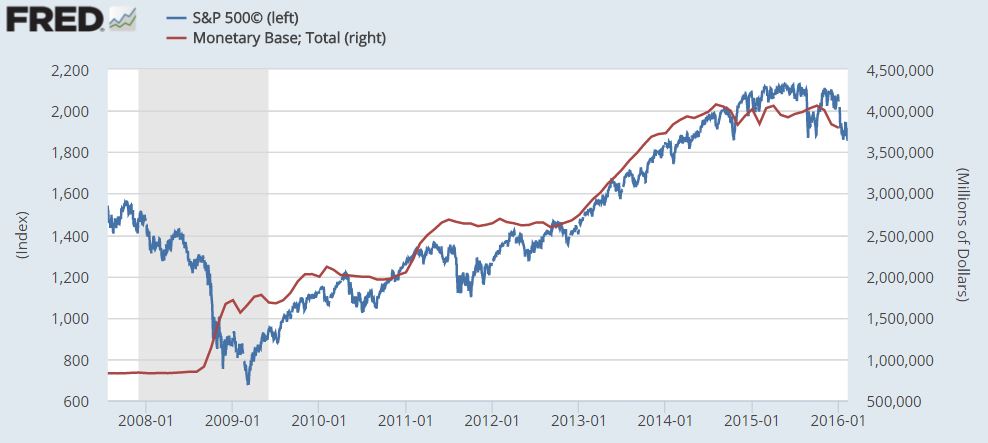
Looking at these points and others (and there are many other we could raise…remember the 2014 Eurozone Bank stress test that revealed the equivalent of nearly 10% of EZ GDP in bad debts?) the current malaise in the banking system could simply be a self feeding fear frenzy as a multitude of investors re-assess their risk positions, after all reprising one of our favourite charts shows how the support for the US market to defy logic for years has been removed since QE3 ended towards the end of 2014:
Source: St Louis Fed, AG Click/Tap to Enlarge
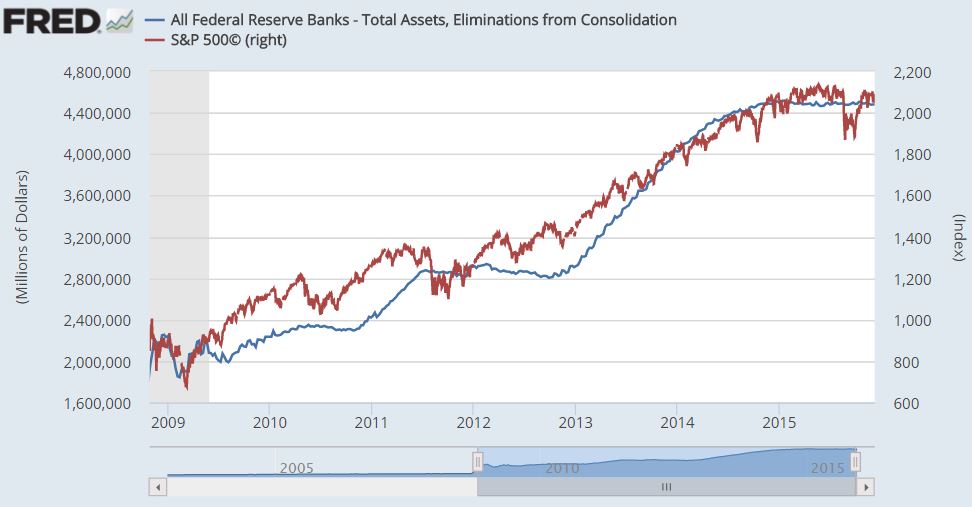
Now this overlays the S&P (in Blue) with, in this case ,the US monetary base, which the eagle eyed will notice is a little different from the chart normally used, which is Federal Reserve Balance Sheets, swollen with QE purchases. We use this chart to show another measure of the effect of QE, effectively money printing…hence the growth int he monetary base…..with the greater volatility this measure suffers during Fed fallow periods as other forces come to bear. Hence as QE ended, rather than the flat line of the Fed balance sheet, we see a more volatile line, mirroring the growing volatility in the equity markets. The alternative view from the end of 2015 is below to compare:
Source: St Louis Fed Click/Tap to Enlarge
However either view shows how important QE has been to the US market, without it it is harder to defy reality, hence our position in 2014 that while the Fed might get away with raising rates by up to 0.5% (so far just 0.25%) QE4 would be likely before they moved any higher.
Without this crutch reality is reasserting itself, although not all see it that way as last night on CNBC they were discussing the danger of self-fulfilling circles downwards, although we feel they missed the point. QE and debt delusions created a self-fulfilling circle-up, based upon maths that don’t ultimately work, if that bubble has burst (and the market technical’s give ever less reason to anticipate a bounce soon….although it can’t be ruled out) then it isn’t a self-fulfilling fall, simply the reassertion of fundamentals.
Hence the Grizzly Prometheus is not yet panicking as the chances are all we are seeing is reality beginning (and we mean JUST beginning) to bite, although it would be sensible to watch these markets like a hawk. You might not worry about the whole Greek market falling 10% yesterday, but Japan falling over 5% last night….that’s unusual.
Please remain very careful and if you think you are sure you know what’s going on stop and think because I guarantee you don’t, you really, really can’t!